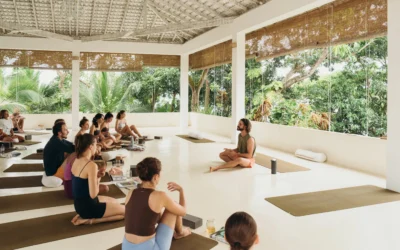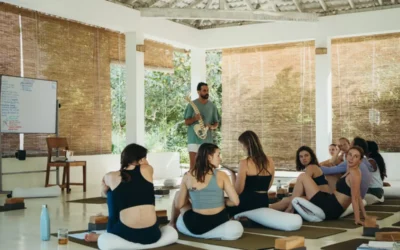
I’ve practiced every kind of yoga: Ashtanga, Iyengar, Vinyasa, Yin. I’ve also dealt with every type of yoga injury: shoulders, knees, SI joints, and the list goes on. The method that changed how I move (and teach) is Yoga Synergy, developed by physiotherapists Simon Borg-Olivier and Bianca Machliss. It’s evidence-based, spine-safe, and works for every body.
These eight principles sit at the core of it. Four things to do more of. Four things to dial back. Once you feel them in practice, you can’t unfeel them.
They aren’t just yoga rules either. They apply to any movement. Lifting weights, going for a run, practicing Tai Chi, walking up stairs. If you move, they’re useful.
Four Things to Do More Of
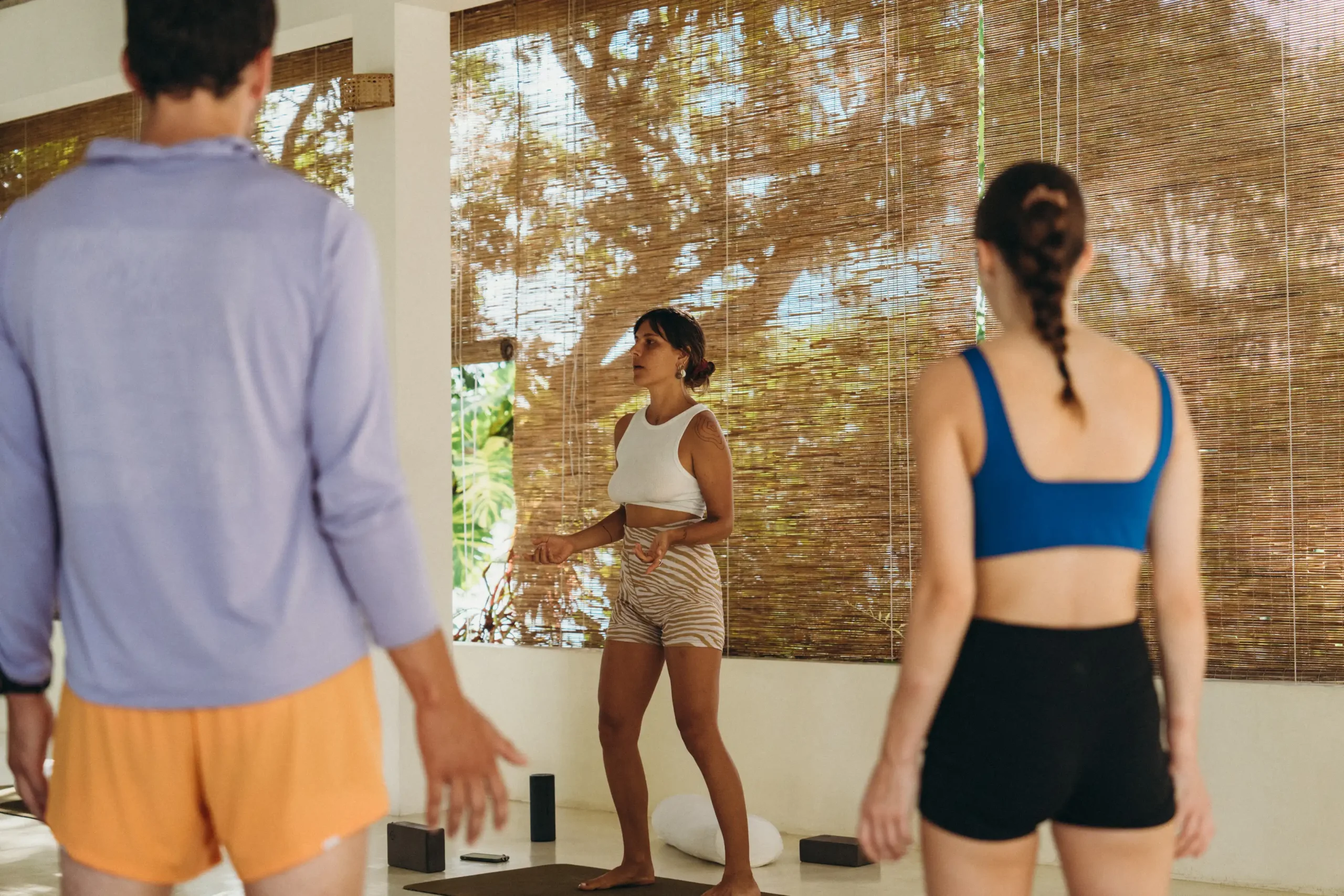
The first four principles are habits to build into every practice. Not every pose or movement has to follow them perfectly, but the more often you apply them, the more benefit you get.
1. Move Actively
Move without help from gravity, momentum, or your arms. The body moves itself.
Active movement isn’t collapsing into a forward fold or letting your leg drop into a lunge. It isn’t grabbing your foot and pulling yourself deeper into a stretch. It isn’t using your hands to push further into a twist. All of those are passive for the joint doing the work, and that’s where the trouble starts.
When you move actively, the spinal muscles shape the spine. The leg muscles move the leg. If you want to go deeper into a pose, the muscles that create that shape are the ones doing the work.
Why it matters:
- Fewer injuries. When gravity or your arms push the body around, the only thing stopping the movement is a stretch reflex, a bone, or an injury. Active movement keeps you inside a healthy range.
- Better control. You build genuine strength and coordination in every joint, through every range you visit.
- Real whole-body strength. Passive practice only strengthens the muscles doing the pushing, usually the arms. Active practice strengthens everything involved in the shape.
2. Move From the Core
The spine and core move first. The limbs follow.
This is not the same as activating or bracing the core. Activating is a single on-switch. Moving from the core is shaping the torso towards the pose before the arms or legs go anywhere.
In a twist, the spine twists first, then the arms reach. In a forward fold, the spine rounds first, then the hips fold. In a backbend, the spine lengthens and arches first, then you lean back.
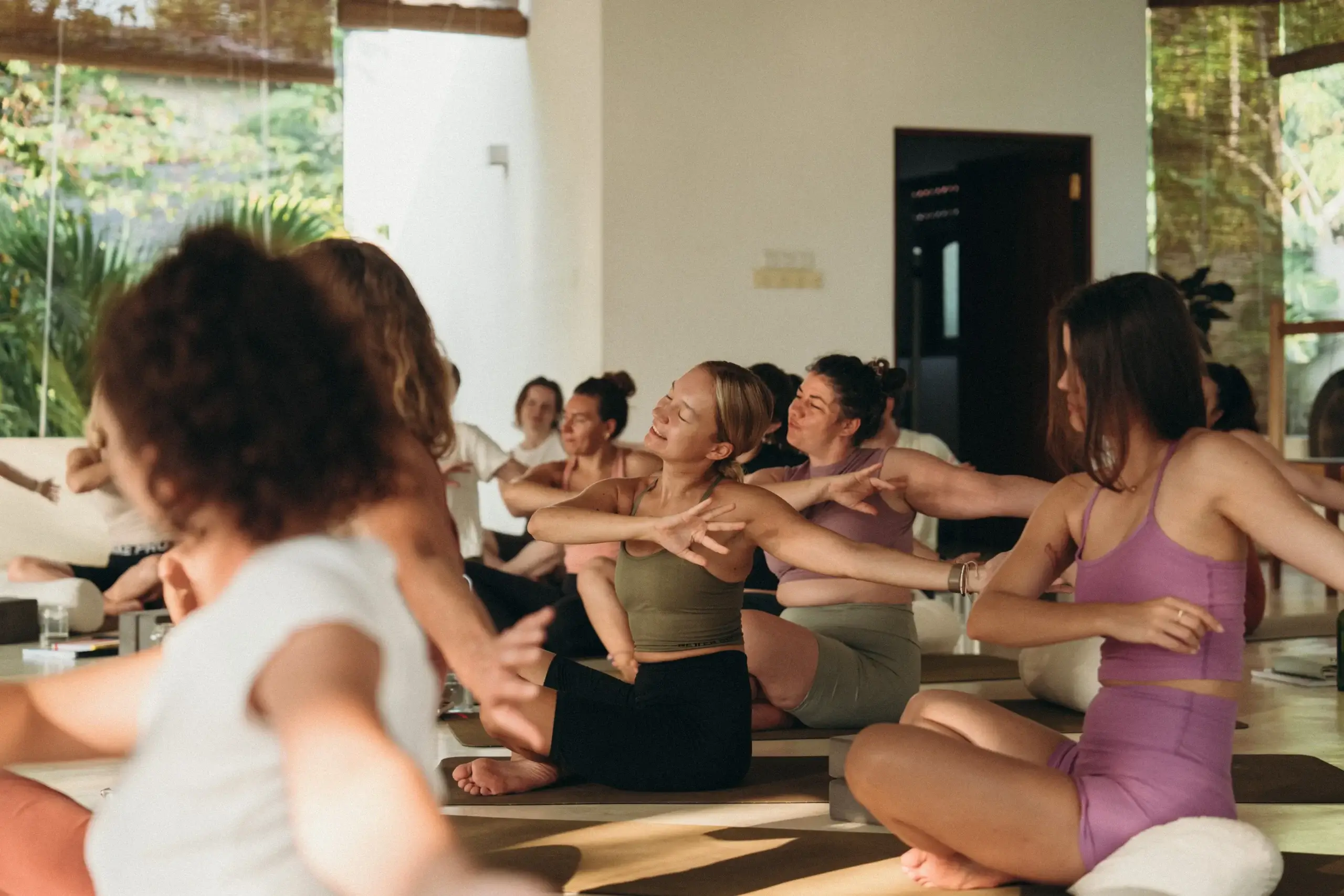
When the limbs lead and the core follows, the core muscles tend to switch on in the wrong way. They tense to stop you going further rather than creating the shape itself. You end up fighting your own body. Breath gets tight, the back gets tense, and the pose feels harder than it should.
Why it matters:
- Protects the spine. You never pull the torso into a position the core wasn’t ready for.
- Strengthens the core in every pose. Every shape becomes a specific, functional core exercise.
- Keeps you relaxed. Less unnecessary tension through the torso means better breathing, better circulation, less stress.
- It’s efficient. Leading with the core is simply the most fluid, least effortful way to move between shapes.
3. Move Fluidly
Move like you’re underwater. No hard stops, no jerky starts, no slamming into the end of a range.
Fluid movement also means using more than one direction at a time. A joint moving in a single line (forward and back, up and down) is mechanical. A joint moving through multiple ranges creates circles and spirals. Think Qi Gong rather than boxing.
Why it matters:
- Fewer injuries. Harsh starts and stops are where strains happen.
- Better circulation. Smooth movement pumps blood and lymph around the body and takes load off the heart.
- A calmer nervous system. As the heart softens, the parasympathetic system engages and you relax.
- Healthier joints. Circular movement keeps synovial fluid flowing through the joint.
4. Breathe Naturally
Let the breath follow the movement. Don’t force it to lead.
Modern yoga often instructs the breath. Inhale here, exhale there, deep ujjayi throughout. That can feel powerful, but it usually means breathing more than the body actually needs, and it disrupts the natural pattern between movement and breath.
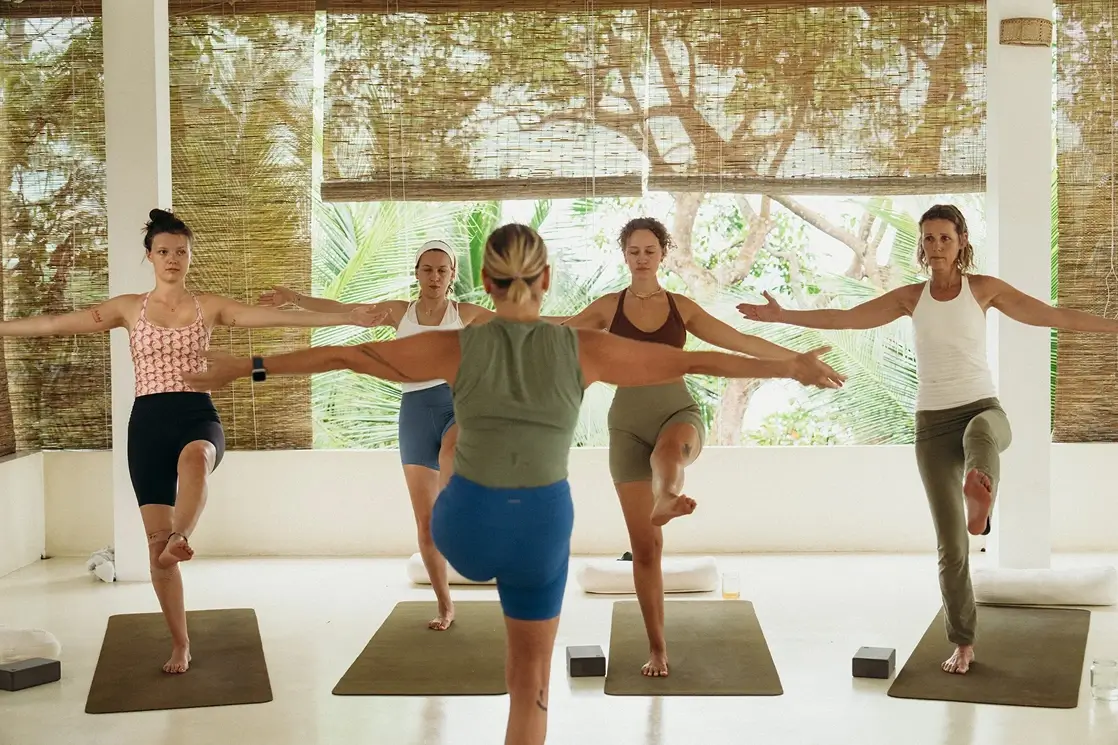
Natural breathing is gentle, nasal, into the belly, and a little less than you think. The breath is observed, not controlled.
Why it matters:
- Matches movement to physiology. When the body leads and the breath follows, both systems work together instead of against each other.
- Lowers stress. Forced, heavy breathing triggers the sympathetic nervous system even when the practice is meant to be relaxing.
- Frees up attention. When you’re not counting breaths, you have more room to notice movement, sensation, and whatever else the practice is showing you.
Four Things to Dial Back
The next four are habits to do less of, not to eliminate. Stretching, tensing, breathing, and thinking all have their place. Most yoga practitioners simply do them more than they need to.
5. Stretch Less
Stretching is one tool for gaining flexibility. It isn’t the only one, and it often isn’t the best one.
The feeling of stretch isn’t the muscle reaching its length. It’s the nervous system deciding you’ve gone far enough and tensing the muscle to stop you. Pushing past that sensation is essentially arguing with your own body. If the argument goes on too long or with too much force, something gets hurt. “Yoga butt”, chronic inflammation of the hamstring attachment, is the classic example of what happens when this argument runs for years.
Stretching can work, but only when held long enough (20 to 30 seconds minimum) for the inverse myotatic reflex to engage. Short, bouncy stretching gives you all the risk and none of the reward.
There are better tools. Full-range active movement teaches the nervous system that the end of your range is safe. Reciprocal activation (contracting one muscle to release its opposite) works with the body rather than against it. Relaxation alone often adds range.
Stretch when there’s a reason to. Use alternatives the rest of the time.
Why it matters:
- Fewer overuse injuries, especially at tendon attachments.
- Less physiological stress from the stretch-and-resist cycle.
- Flexibility that actually holds, because it’s built on nervous system adaptation rather than forced range.
6. Tense Less
Bracing is useful when a joint is vulnerable. Most of the time, it isn’t.
Co-activation (tensing muscles around a joint to protect it) has a proper name, bandha, and a proper use. It belongs in moments where the joint is loaded, exposed, or at genuine risk. It does not belong in every pose, around every joint, for the whole class.

Two mistakes show up constantly. First, tensing muscles that don’t need protecting. There’s no reason to lock the elbows when your arms are overhead, or grip the knee when the leg is floating behind you in Warrior Three. Second, tensing harder than necessary, on the assumption that more tension equals more safety. It doesn’t. More tension equals more wasted energy and more stress.
The goal is the least tension needed to create the movement and keep the joint safe. Everything else can soften. The belly, the jaw, the fingers, the face.
Why it matters:
- Better circulation. Over-tensed muscles restrict blood flow. The heart has to work harder to push blood past them.
- Less physiological stress. Relaxation downstream of tension shifts the nervous system toward rest and digest.
- More flexibility. A relaxed muscle is a long muscle. A tense one is a short one.
- Less pain. A significant share of musculoskeletal pain, including most chronic lower back pain, is driven by sustained low-grade tension.
7. Breathe Less
Breathing keeps you alive. Breathing more than you need doesn’t make you more alive. It makes you more stressed.
Over-breathing triggers the same physiology as strong coffee. Heart rate climbs, muscles tense, pupils dilate. It can feel energising, but it’s the body’s stress response in a nice wrapper. It also disrupts blood chemistry. Hyperventilation lowers carbon dioxide, which impairs oxygen delivery to tissue (the Bohr effect) and shifts blood pH. Dizziness, lightheadedness, and breathlessness follow.
Breathing slightly less than feels natural does the opposite. It activates the parasympathetic nervous system, lowers heart rate, improves oxygen absorption at the tissue level, and dilates blood vessels.
This is a small, careful adjustment. Not a breath hold, not hypoxic training, not anything that requires effort. Just a little less than you think you need.
Why it matters:
- Shifts the nervous system into rest and digest.
- Lower heart rate with no loss of oxygen at the tissue.
- Better CO₂ tolerance, which improves how efficiently oxygen moves from blood into cells.
- Dilated blood vessels, improving circulation to the brain, extremities, and organs.
8. Think Less
Thinking happens in the gaps. If your attention is on movement, sensation, and breath, there’s no gap for rumination to fill.
This is less a technique and more a consequence of doing the other principles well. Active movement, core-led transitions, fluid pacing, natural breathing. All of it demands attention. When attention is fully on the practice, the mental chatter has nowhere to land.
The physiology follows. Mindfulness deepens parasympathetic activation. The body moves toward rest and digest, the emotional state softens, and the mental state tends to follow the body rather than lead it.
You don’t make this happen by trying to stop thoughts. You make it happen by being genuinely occupied with what you’re doing.
Why it matters:
- Less rumination, which is strongly linked to anxiety and low mood.
- Deeper physiological relaxation through sustained mindful attention.
- A more settled emotional state that carries past the end of the practice.
Putting the Principles to Work
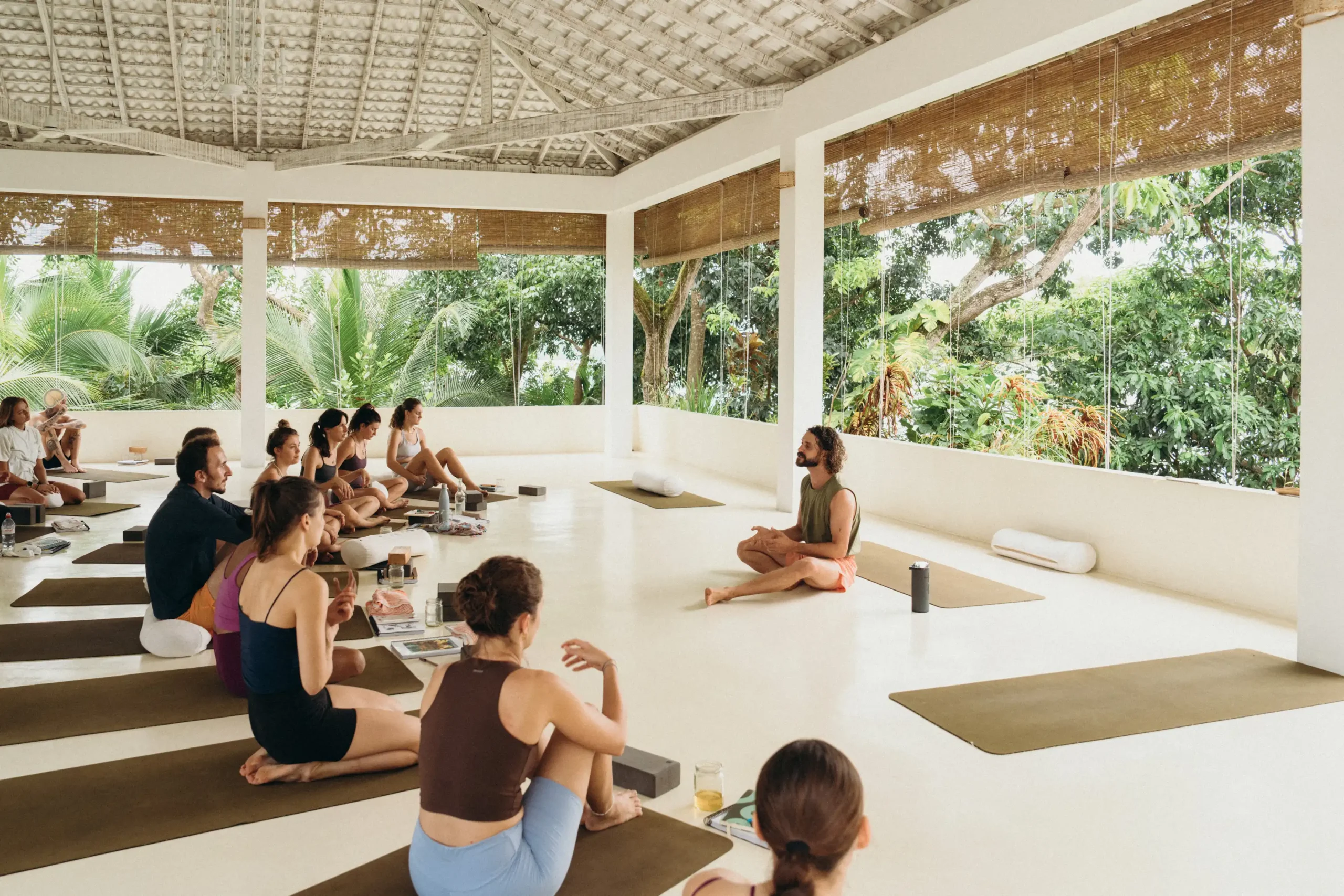
Start every practice with the four to do more. Move actively, lead with the core, keep it fluid, let the breath follow. That’s the foundation.
The four to dial back come in whenever you notice yourself gripping. Too much stretch, too much tension, too much breath, too much noise in the head. They’re less about changing what you do and more about removing what’s in the way.
Apply them on the mat. Apply them at the gym. Apply them on a walk. They work in any setting where the body is moving, because they’re principles of how the body actually works, not rules for a specific style.
Want to learn these principles in full? Start with my Online Course, or join me in Sri Lanka at the next 200-Hour Synergy Vinyasa Teacher Training.