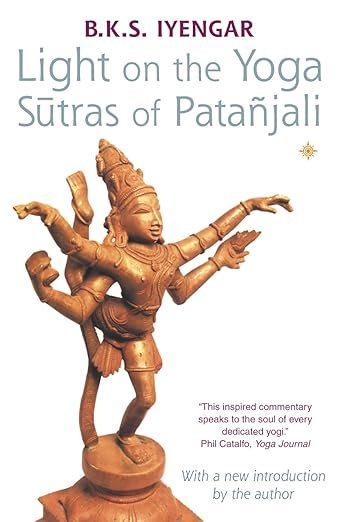
The 8 limbs of yoga come from a 2,500-year-old Sanskrit text called the Yoga Sutras, written by a sage called Patanjali. Until Patanjali wrote them down, yoga was taught through myth and story. The Sutras were the first time anyone really simplified it, and the 8 limbs are the simplification I find most useful.
The text is made up of 196 short verses, rarely longer than a sentence each, arranged in four chapters. In the second chapter, Patanjali lays out the 8 limbs. In Sanskrit, the whole framework is called Ashtanga, which literally means “eight limbs”. (Yes, this is where Ashtanga Yoga gets its name. The style most people know today, the one from Pattabhi Jois, is a much later interpretation.)
The 8 limbs are a progression. You start with how you treat the world, move into how you treat yourself, then into the body, the breath, the senses, the mind, and finally the state the whole thing is pointing toward. You don’t need to climb them in a perfect order, and most of us won’t. But having them laid out like this gives you a map.
Here they are.
1. Yamas — How You Treat the World
The Yamas are five ethics for how you show up in the world outside yourself. They come first, and I think that’s important. If your life off the mat is a mess, the rest of the practice is going to struggle.
Patanjali defines most of them as the opposite of something, which is an interesting clue. The point isn’t to avoid the bad thing. It’s to actively practise what lives on the other side of it.
- Ahimsa — the opposite of violence. Kindness and care, toward others and toward yourself, in thought, word and action.
- Satya — truthfulness. Being honest and authentic, while staying aware of how your truth lands on others.
- Asteya — the opposite of stealing. Respecting other people’s belongings, ideas and time. It also encourages generosity, giving freely without expectation.
- Brahmacharya — the proper direction of your energy. Balance and mindfulness around sensual and material pleasures.
- Aparigraha — the opposite of hoarding. Letting go of possessiveness, toward things, people and outcomes.
2. Niyamas — How You Treat Yourself
Where the Yamas point outward, the Niyamas point inward. Five personal disciplines to practise on yourself.
- Saucha — cleanliness. Of body, of mind, of the spaces you live and work in.
- Santosha — contentment. The capacity to feel okay with what you have, right now.
- Tapas — discipline and determination. Showing up for your practice and your life, especially when it’s hard.
- Svadhyaya — self-study. Regular self-reflection and learning.
- Ishvara Pranidhana — surrender. Letting go and accepting what is. If you connect with the idea of a higher power, acknowledging that. If you don’t, just acknowledging that you’re not running the universe.
3. Asana — Posture
This is the one most people think of when they hear the word “yoga”. The physical practice. Postures. What you do on a mat.
But Patanjali barely mentions asana in the Sutras. In his time, asana meant a steady, comfortable seat for meditation. Nothing more. The vast physical practice we know today came much later.
That doesn’t make modern asana less valuable. A strong, healthy body that moves well is the ground everything else is built on. But it’s worth knowing that asana is one of eight limbs, not the whole tree. This is a big part of what shapes the Yoga Synergy method — treating asana as a tool that serves the rest of the practice, not as the practice itself.
4. Pranayama — Breath Control
Prana is often translated as “life force”, which sounds mystical but is actually pretty practical. It’s the energy that moves through you. Pranayama is the conscious control of the breath to influence that energy, and through it, the nervous system.
Breathwork is one of the most direct tools you have for shifting your state. Slow breathing calms you. Fast breathing energises you. Holding the breath builds focus. The physiology is real. The effects are immediate. Pranayama is where yoga gets genuinely powerful, and it’s a part of the practice most modern classes barely touch.
5. Pratyahara — Withdrawal of the Senses
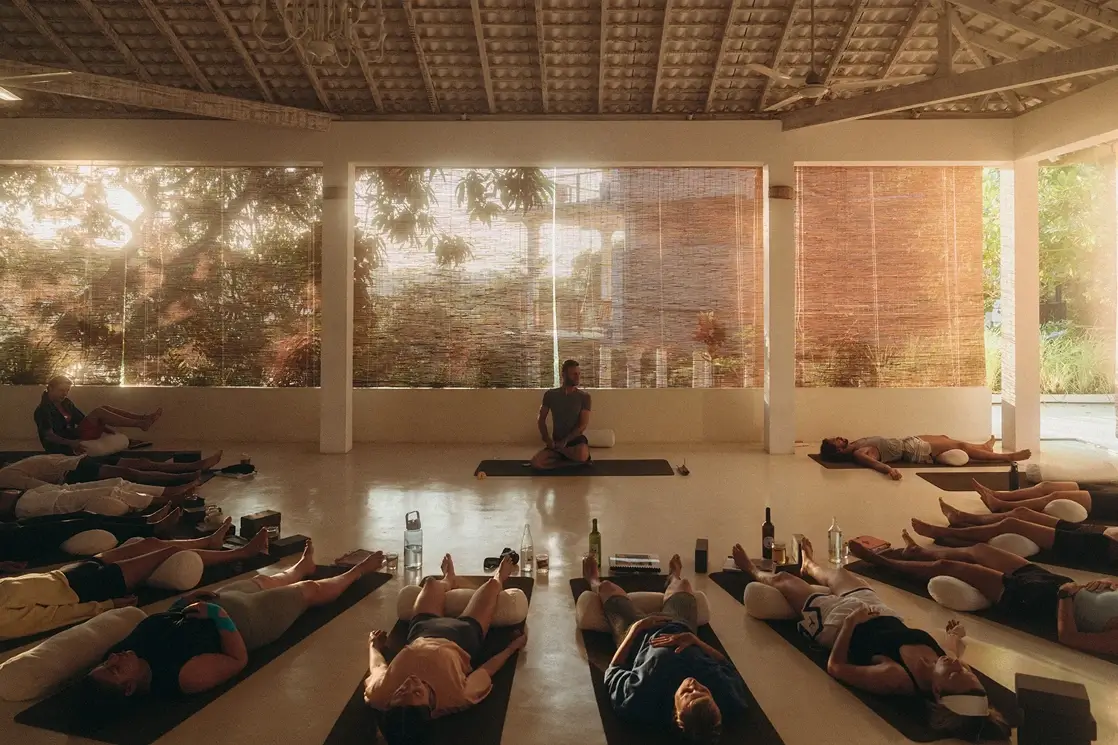
Pratyahara is the bridge between the outer limbs and the inner ones. It’s the practice of drawing attention away from external stimulation and turning it inward.
In practical terms, this is what happens when you close your eyes in savasana and stop tracking the sounds in the room. It’s why we dim the lights and quieten the space for meditation. You’re training the nervous system to stop reacting to every little thing, so that the next limbs become possible.
6. Dharana — Concentration
Dharana is intense, focused attention on one thing. A mantra, the breath, a visual object, a single thought. You pick a point of focus and work to sustain it.
This is the gateway to real meditation. Without Dharana, the deeper limbs aren’t really available.
7. Dhyana — Meditation
Once Dharana is steady, something starts to happen. The mind begins to fill in the gaps with visualisations, sensations, or a kind of flow. This is Dhyana.
It’s often translated simply as “meditation”, though it’s more specific than that. Some describe it as transcendental, some compare it to meeting god, some compare it to the effects of certain drugs. Whatever the framing, it’s what happens when focus has been held long enough that the usual chatter of the mind falls away.
8. Samadhi — Yoga
Samadhi gets described as enlightenment, the end of suffering, the ultimate goal. All true, probably. But a simpler way to think about it: Samadhi is the peak experience of yoga. A moment where you feel completely united with the present, with your breath and nervous system settled, and your mind quiet.
It’s not something you do. It’s something that happens when everything else falls into place.
Samadhi can be momentary or last a while. It can happen in yoga, in meditation, or in the middle of doing something you love. A lot of people describe a similar feeling when they’re fully absorbed in a favourite activity. Another way to put it: Samadhi is the peaceful gap between thoughts.
Interestingly, Buddhism arrived at something very similar around the same time. The Buddhist Eightfold Path ends with samma samadhi, right concentration, pointing toward the same experience. Two ancient philosophies, working independently, describing the same peak state.
Why the 8 Limbs Still Matter
The 8 limbs were written down 2,500 years ago and they still hold up. They’re practical, not mystical. They describe a progression from how you live, to how you move and breathe, to how you focus, and finally to the state the whole thing is pointing toward.
You don’t need to master them in order. Most of us are working on several at once, doing better at some than others, and that’s fine. What the framework gives you is a sense of what yoga actually is, beyond the postures. And in a modern practice that’s become heavily physical, that’s a useful thing to hold on to.
If you want to sit with this material properly over a few weeks, it’s the backbone of what we teach across our Yoga Teacher Trainings at Lanka Yoga in Sri Lanka. If you’re after more reading in the meantime, have a look at 6 Yoga Books every new teacher should actually finish.